timing attack
patch — the golden rule
Vision · Space · Position
mental performance
In the gosu tiers of StarCraft: Brood War, playing fast is just the bare minimum. What actually makes a great Terran player is controlling the map and putting your units in the right spots. This playbook is designed to help you stop blindly following build orders and start thinking like a pro.
Having fast hands and a good economy just gets you a seat at the table. Outsmarting your opponent and dominating the battlefield is how you actually win. The Terran race rewards methodical, calculated play — and punishes improvisation more harshly than any other race.
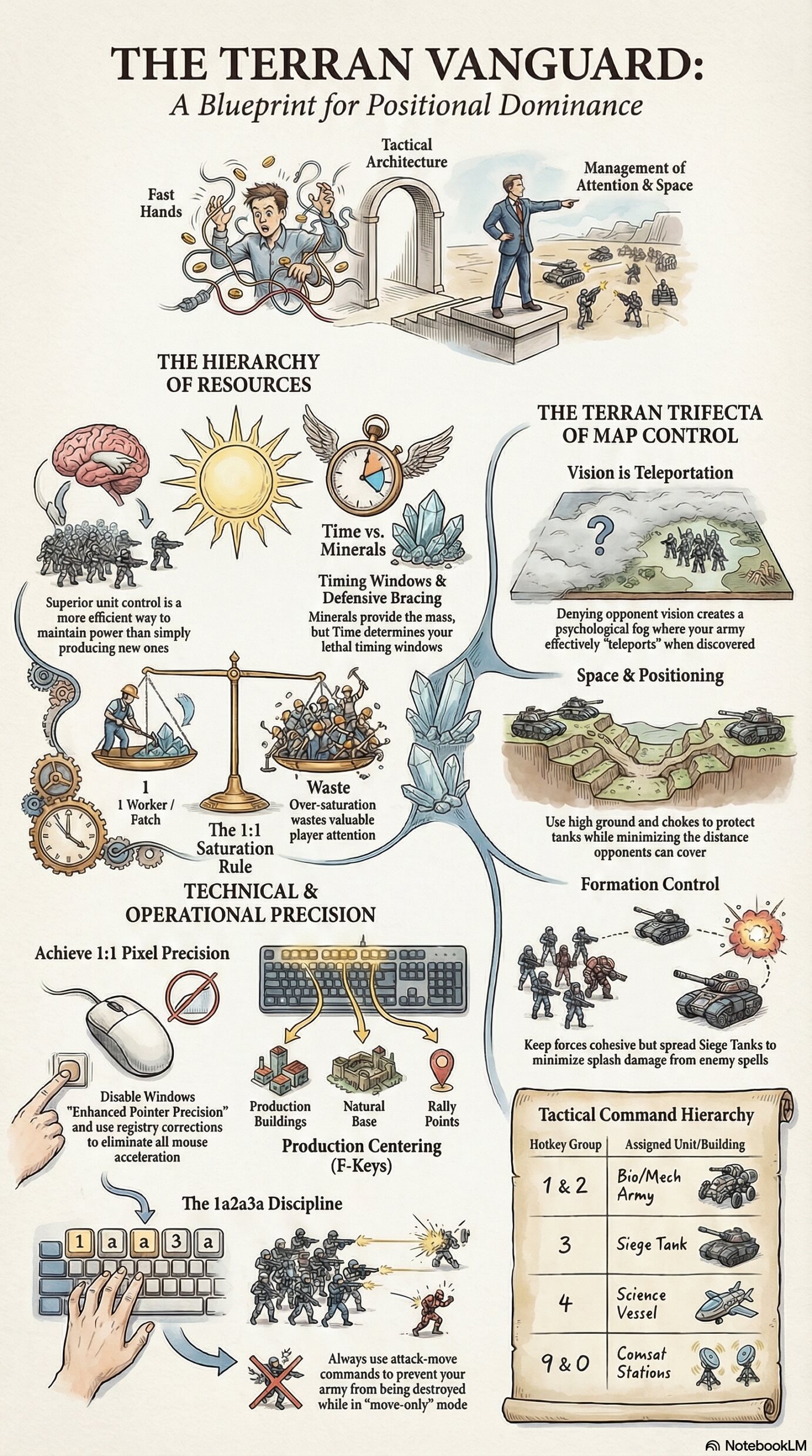
The Strategic Architecture of Terran Play
How well you play comes down to managing three resources at once. Minerals and gas pay for your army, but your own attention is actually the most limited and most easily drained resource you have. A Terran player who manages attention well will always outperform one who is merely fast.
The Resource Hierarchy
Attention sits at the top — your cognitive bandwidth determines everything else. Below it is Time, which governs your timing windows and when your army becomes lethal. At the base are Minerals, which provide the mass. Minerals build armies; Time determines when those armies strike; Attention decides whether those strikes land.
Terran units are weak on their own — they only win fights when grouped together in large numbers. If your army is spread out, it is going to get destroyed. You need to move your forces as one solid, unified group. Superior unit control is a more efficient way to maintain power than simply producing new ones. Before you can start playing mind games with your opponent, you have to master the fundamentals of grouping and movement.
"The map is not something that happens to you. It is something you shape — one Siege Tank, one choke point, one scan at a time."
Operational Fundamentals and Macro Precision
Macro-management is more than just building stuff — it is what actually gives you the freedom of choice going forward in the game. If you forget to keep producing, even your most brilliant strategies will not matter.
Economy 101: The 1:1 Saturation Rule
Efficiency is governed by a simple rule: one SCV per mineral patch (at least till you saturate all your mineral patches). Over-saturation wastes your attention and does not gather resources any faster. Once you saturate your main, additional SCVs go to the next base.
- Main Expansion (9 patches): Pile no extra workers onto a single patch. Saturate, then transfer.
- Natural Expansion Transfer: When the Natural Command Center completes, immediately transfer 4–5 SCVs to reach the 7-worker baseline (modern maps have 7 minerals at the natural).
- The Second Gas: Do not take your second Refinery until every mineral patch at the Natural has an active SCV. Gas before saturation is wasted worker time.
Hardware and Software Precision
Precision begins at the OS level. A Gosu Terran player does not fight against their own hardware.
Disable "Enhanced Pointer Precision" in Windows mouse settings. Then apply registry corrections to eliminate all forms of mouse acceleration. Your cursor must move with 1:1 pixel precision to ensure your Siege Tanks hit exactly where you point them. This is not optional at a competitive level.
The Command Hierarchy (Hotkeys and F-Keys)
Your hotkey layout must evolve as the game progresses. Early game chaos gives way to a structured command hierarchy by mid-game:
- Early Game: 1 = Command Center, 2 = Scouting SCV, 3 = initial Marines, 4–6 = Barracks / Factories.
- Mid-to-Late Game: 1 & 2 = Bio/Mech Main Army (Marines, Medics, Vultures), 3 = Siege Tanks, 4 = Science Vessels, 9/0 = Comsats.
Precision Execution: The 1a2a3a Discipline
The 1a2a3a command sequence is how elite Terran players move their army. Instead of clicking once and hoping, you issue attack-move commands across all your control groups in rapid succession. This ensures every unit is always attacking and prevents your army from being destroyed in "move-only" mode when the opponent engages unexpectedly.
Use "Magic Box" techniques and formation movement to prevent unit clumping. Keep your army formation cohesive, but spread your Siege Tanks so they will not take extra splash damage from a successful Zealot Bomb or Psionic Storm. Rally discipline matters too — update rallies in under one second so reinforcements flow automatically while your eyes stay on the front line.
The Terran Trifecta: Vision, Space, and Positioning
Vision, Space, and Positioning constitute the "Terran Trifecta." These are the non-mineral resources that determine whether a match is a masterclass or a slaughter. Mastering all three simultaneously is what distinguishes a truly dangerous Terran player.
Vision is Teleportation
When you deny your opponent's vision through Observer or Overlord denial, you create a psychological fog. Without information, your opponent cannot gauge whether you are unsieged and scattered or massed and ready to strike. To them, your army "teleports" to their natural the moment they realize they have lost track of you.
Use Scans and Goliaths to constantly hunt down Observers. The moment you destroy your opponent's vision, every movement you make becomes a surprise. An unscouted Terran army with 8 Siege Tanks is one of the most psychologically devastating threats in the game — the opponent must assume worst-case positioning at all times.
Space and Positioning: The Containment Doctrine
Containment — locking an opponent into their natural — is the cornerstone of Terran positional play. The goal is not simply to attack, but to deny economic expansion while your own economy grows uncontested.
- Choke Selection: Identify the narrowest engagement zone outside the enemy natural. The narrower the choke, the fewer units the enemy can bring to bear at once.
- Siege Arc: Deploy Tanks in a semi-circle so their firing ranges overlap, covering all dead zones within the arc.
- Minefield Buffer: Use Vultures to lay a dense minefield in front of the arc. This forces the opponent to clear mines while under fire from your Tanks, shredding their "death ball" before it even reaches your line.
- High-Ground Priority: Occupy elevated positions whenever possible. Attackers firing from low ground have a 50% miss chance against units on high ground — your Tanks effectively become twice as durable.
Formation Control and Space Management
Keep your forces cohesive but manage the space they occupy deliberately. Spread Siege Tanks to minimize splash damage from enemy spells while keeping your bio forces tight enough to benefit from Medic healing. The distance between your units is as important as the units themselves.
Advanced Manipulation: Tactical Denial and "The Pull"
Elite Terran play involves forcing the opponent to choose between two unfavorable outcomes through tactical trickery. You "pull" the enemy army out of position and create the opening for one decisive, overwhelming strike.
Observer Denial and Scan Priority
Scans are finite. You must prioritize thoughtfully. Detecting invisible threats — Dark Templars in TvP or Lurkers in TvZ — is the absolute top scan priority. Never waste a scan on map vision if you risk being blind to a cloaked all-in. Goliaths with Charon Boosters are your primary Observer-hunting tool; Scans are the emergency backup.
The Pull: Tactical Misdirection
The most powerful Terran attacks are not frontal assaults. They are carefully orchestrated feints that make the opponent commit their army to the wrong location at the wrong time.
- The Vulture Backstab: While your main army threatens the front, send 6–8 Vultures to the opponent's third base or mineral line. The opponent must pull their main army back, leaving the front door open for your Tanks to advance.
- The Fake FD (Psychological Bait): Show an army of exactly 5 Marines, 1 Tank, and 1 Vulture. The opponent assumes a standard opening and stops scouting for tech — masking a fast Dropship transition designed to devastate their main base.
- The Minefield Wall: Lay Spider Mines in reinforcement paths. This separates the enemy army, allowing you to engage a "low unit count" force while their reinforcements are trapped behind minefields — or dead if they move through them.
Target Selection Hierarchy
When you do attack, prioritize targets in strict order. Undisciplined targeting wastes the damage output that your Siege Tank positioning has earned.
- Priority 1 — Nexuses / Worker Lines: Economic death. Killing workers deals compounding damage that lasts the entire rest of the game.
- Priority 2 — Production Facilities: Reinforcement denial. A destroyed Robotics Facility or Hatchery cannot replace the units you are about to kill.
- Priority 3 — Low-ground bases vs. high-ground fortresses: Always engage the easier target first. Never assault an entrenched high-ground position when an undefended economic expansion exists.
TvP: The Positional Grind
Against Protoss, the Terran goal is to prevent or weaken a mass-Carrier or Arbiter tech switch through containment. The longer the game goes without establishing a contain, the more likely the Protoss is to reach a late-game composition that is nearly impossible to fight directly.
The Hiya Build — 8-Tank Timing Attack
The Hiya Build targets an 8:05 timing where you move out with a fully Siege-capable force before the Protoss can establish a stable three-base economy or complete their gateway army.
Handling a Carrier Switch
When the Protoss commits to Carriers, change your response immediately. First, target the ground army to eliminate counter-attack potential — Carriers are worthless if the Protoss cannot protect their economy. Then deny their economy; Carriers require a high-income Interceptor bank to remain effective. Transition to mass Goliaths with Charon Boosters (Goliath range research) and use Science Vessels for EMP on Carriers and Arbiters.
TvZ: Vessel Timing and Pressure
Against Zerg, the name of the game is preventing the Mutalisk stack from ever becoming viable. A well-timed Science Vessel with Irradiate ready turns the Zerg's key aerial harassment unit into a liability rather than an asset.
Flash's Science Vessel Build
The benchmark for TvZ excellence targets a 7:12 Science Vessel and 7:30 Irradiate research, specifically timed to neutralize Mutalisk stacks the moment they emerge from the Spire.
The Lurker Pivot
If the Zerg opens Lurker instead of Mutalisk, immediately drop the Irradiate upgrade path and focus on 3–4 Siege Tanks to demolish the Lurker contain. Siege Tanks are the hard counter to Lurkers — respond decisively and do not over-commit to the Vessel tech path when it is not needed.
+1 5-Rax Pressure
The +1 5-Barracks push with 16–20 Marines and 5 Medics, timed to arrive just as the first Mutalisks emerge, forces the Zerg to spend Larva on Zerglings for defense instead of Drones for economy. This pressure does not need to kill the Zerg — it just needs to delay the Drone count enough that your macro advantage compounds over the following minutes.
The Right Mindset: Staying Focused and Keeping Your Cool
Your physical posture affects how well you play. If you tense up, your mind gets stiff. Staying physically relaxed gives you the mental flexibility to react quickly to anything the game throws at you. The mechanical and strategic knowledge in this playbook is useless without the mental framework to deploy it under pressure.
Nine Steps to Peak Performance
- Body Posture: Sit up straight with your feet flat on the floor. Good posture helps you breathe easily and stay relaxed throughout long sessions.
- Calmness: Keep your body loose instead of tensing up. Staying relaxed gives you the mental flexibility to adapt when your build order gets disrupted.
- Concentration: Some players use music to block out real-world distractions like background noise or hunger. Give it a try and find what works for you.
- Intention: Know exactly what you want to achieve when you queue up. Setting a clear goal — "I will practice my F-key routine today" — naturally leads to improvement.
- Motivation: Watch how pro Terran players handle the matchups you struggle with most. Seeing a solved problem inspires you to solve it yourself.
- Game Face: Create a quick pre-game routine to help you lock in and leave everyday stress behind before the game starts.
- Confidence: Stop second-guessing yourself. Trust the hours you have put in and let your muscle memory execute.
- Guaranteeing Victory: Focus on securing small advantages — efficient scouting, perfect SCV transfers, up-to-date rally points. Those small victories compound into wins.
- Growth: Always be willing to learn and try better mechanics, like using camera hotkeys instead of slowly scrolling across the map.
Managing Tilt
When you are on a losing streak, the fix is almost always found by looking back at one crucial mistake in your replay. Did you siege your Tanks slightly too far forward? Did you forget to scan for Dark Templars before pushing out? Take a break, figure out what you can learn from the loss, and come back with fresh eyes. Tilt is a signal that you are trying to solve a problem with emotion instead of analysis.
Winning as Terran is not about having the fastest hands — it is about being precise. When you combine a solid economy, a blinded opponent, and smart positions on the map, you step up from being just an average player to being a genuine threat. Getting better requires honest self-reflection: watch your replays with a clear head, paying just as much attention to how you take fights as you do to your worker production. Stay humble about your weaknesses. StarCraft is a game of constant adjustments — so stay relaxed, keep an open mind, and trust the process.