Metabolic Boost
increase
after Pool completes
pool timing
The first few minutes of Zerg vs. Terran are defined by great uncertainty. A Zerg player often starts on the back foot, worrying about the sudden arrival of a proxy bunker rush and staring at an impenetrable Terran wall. However, the entire power dynamic of the matchup changes when the Zerg spends 100 gas researching a single upgrade: Metabolic Boost.
This "speedling" upgrade is the powerful engine that transforms a vulnerable swarm into a dominant force capable of gaining map control and punishing even the smallest gap in Terran's early-game strategy.
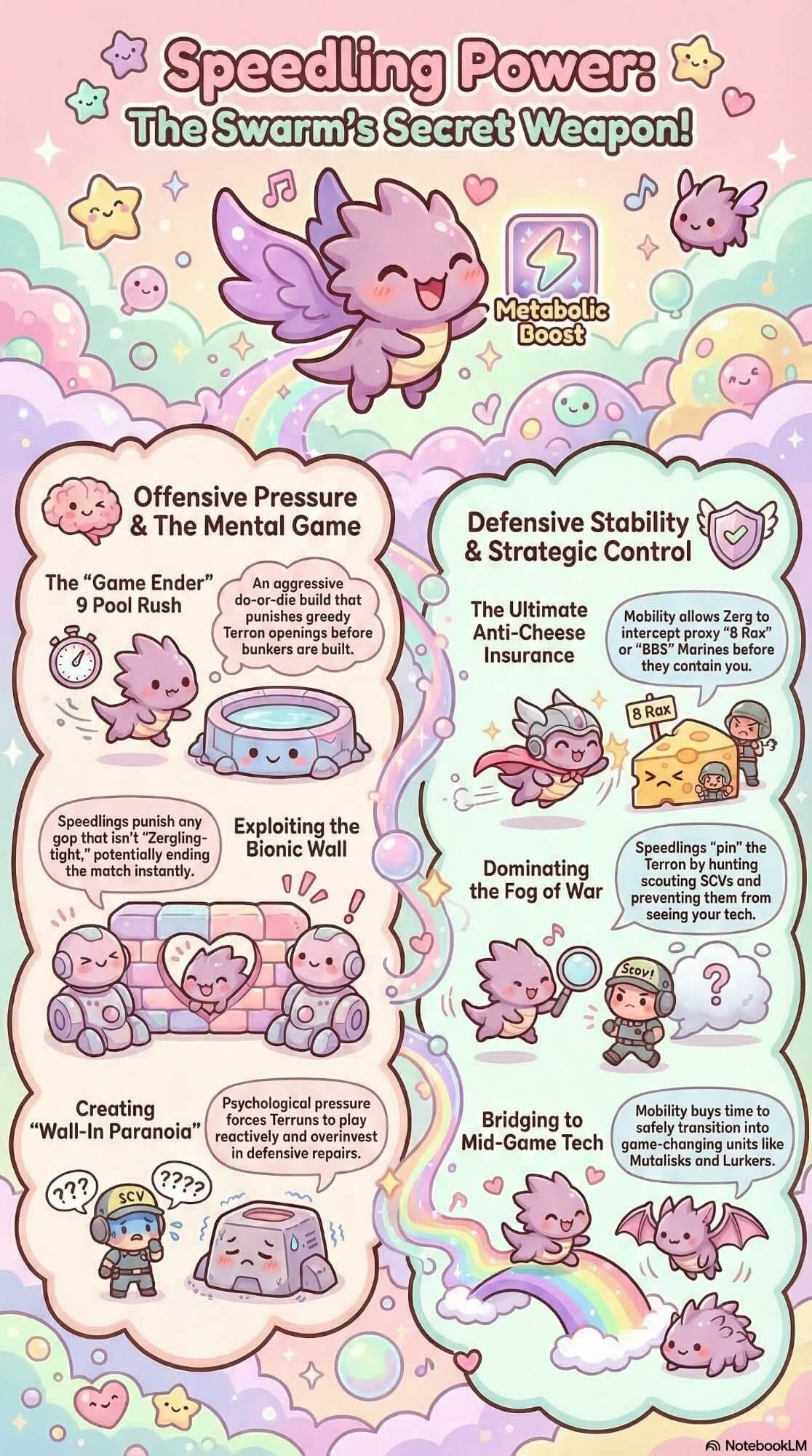
Breaking the Bionic Wall
The Speed Variation of the 9 Pool opening is the most aggressive build a Zerg can make throughout the early ZvT game. It invests heavily in a do-or-die rush, in contrast to the Economic Variation — an economy-oriented build where early Zerglings primarily delay the opponent's expansion.
The Extractor Trick is a tactic used by Zerg players to briefly exceed their supply restriction and obtain an extra Drone or pair of Zerglings before producing their first Overlord.
At 9 supply and around 70–80 minerals, send a Drone to start building an Extractor, decreasing your supply to 8. Immediately construct a Drone, increasing your supply to 9. At this point, cancel the Extractor — which will restore your Drone and set your supply to 10/9.
This method works best with a 9-Pool build order. With the Extractor Trick, you get an extra Drone for a considerable amount of time — because the tenth Drone wouldn't be created until you were done making Zerglings otherwise.
The Mental Game: Wall-In Paranoia
Terran players are constantly worried about the "tightness" of their defences since they face the psychological pressure of speedlings. Speedlings will enter the main base and cause game-ending damage if a wall is not "Zergling-tight" — a technical requirement that prevents Zerglings from moving between the Barracks and Supply Depots.
Due to this danger, the Terran is forced to play reactively, frequently overinvesting in defensive buildings or repairs, giving the Zerg a strategic advantage. Every Supply Depot placed to close a gap is minerals not spent on Marines. Every SCV pulled to repair is a worker not mining.
The Ultimate Insurance: Defence Against Terran Cheese
Beyond its offensive potential, Zergling Speed is essential for defence. Terran players often resort to "cheese" strategies in the ZvT meta — designed to end the game before the Zerg can establish a second base.
"The 9 Pool build is an early Zergling build that provides Zerg with a 'safe' opening versus Terran cheese builds like 8 Rax or BBS."
The 9 Pool Speed opening provides an efficient middle ground. While extreme builds like the 4/5 Pool are the most all-in tools in the Zerg arsenal, the 9 Pool offers stability: it provides the mobility required to intercept Marines from an "8 Rax" or "BBS" (Proxy Barracks) before they can set up a bunker contain.
The 9 Pool Speed sits in the perfect middle ground between the reckless 4/5 Pool (all-in, no recovery if it fails) and the greedy 12 Hatch (vulnerable to early aggression). It is both a weapon and a shield.
Controlling the Fog of War: Scouting Denial and Map Presence
One of the most important functions of speedlings is the suppression of information. In competitive BroodWar, preventing scouting is critical for sensitive tech routes such as the 2 Hatch Muta. Speedlings keep the Terran "pinned" inside their own base by eliminating the initial scouting SCV and hunting down the first few Marines.
This map control works as a bridge: while the speedlings hold back the Terran force, the Zerg can tech up without concern about their moves being deciphered. This pushes the Terran into a nightmare scenario — predict the Zerg tech shift without information. Without scouting, the Terran doesn't know whether to invest in early Engineering Bays and Missile Turrets, or if they can safely move out with their Marine squad and first two Medics.
Every second the Terran spends guessing — Muta or Lurker? Rush or expo? — the Zerg gains a compounding advantage. The speedling's greatest weapon is not its damage output. It is the uncertainty it creates.
The Bridge to the Mid-Game
Zergling Speed is fundamentally about buying time. Because speedlings can pick off stray units, they allow the Zerg to avoid direct, disadvantageous engagements with the main Terran army until Lair-tech units are ready. This mobility is a major instrument to counter the timing of a Terran push.
A successful speedling opening enables the following core ZvT transitions:
- 2 Hatch Muta: Using speedlings to deny scouting and pick off stray units to protect the arrival of the first 6–11 Mutalisks. The Terran must guess whether to build Turrets — and guess wrong either way.
- 2 Hatch Lurker: Utilizing the threat of a speedling "backstab" to keep Terran defensive until Lurkers can establish a contain or defend the natural expansion.
Metabolic Boost is more than just an increase in movement speed — it is the foundation for the remaining part of the Zerg strategy. Even as the game develops to the late phases of Hive technology, Zerglings remain the Swarm's heartbeat. They are the primary targets for the Defiler's Consume ability, giving their cheap lives to supply the 50 energy required for game-changing spells such as Dark Swarm or Plague. The initial 100 gas investment sets the tone for the whole match.
In a game of seconds — is it ever truly safe to delay your Metabolic Boost, or is the risk of a Terran bunker rush too great to ignore?