still evolving
infinitely asymmetric
balance patch
group maximum
On the surface, StarCraft: BroodWar is just an outdated game about space marines fighting aliens. But if you have actually ground through the competitive ladder — or gotten demolished by someone halfway across the world — you know it is a beautifully brutal experience. A game that has not had a balance patch in over 25 years, yet strategies are still evolving and players still ruthlessly punish you for the tiniest mistake.
Whether you are new to the game or returning after years away, these are the mechanics, quirks, and moments of chaos that make BroodWar permanently unforgettable.
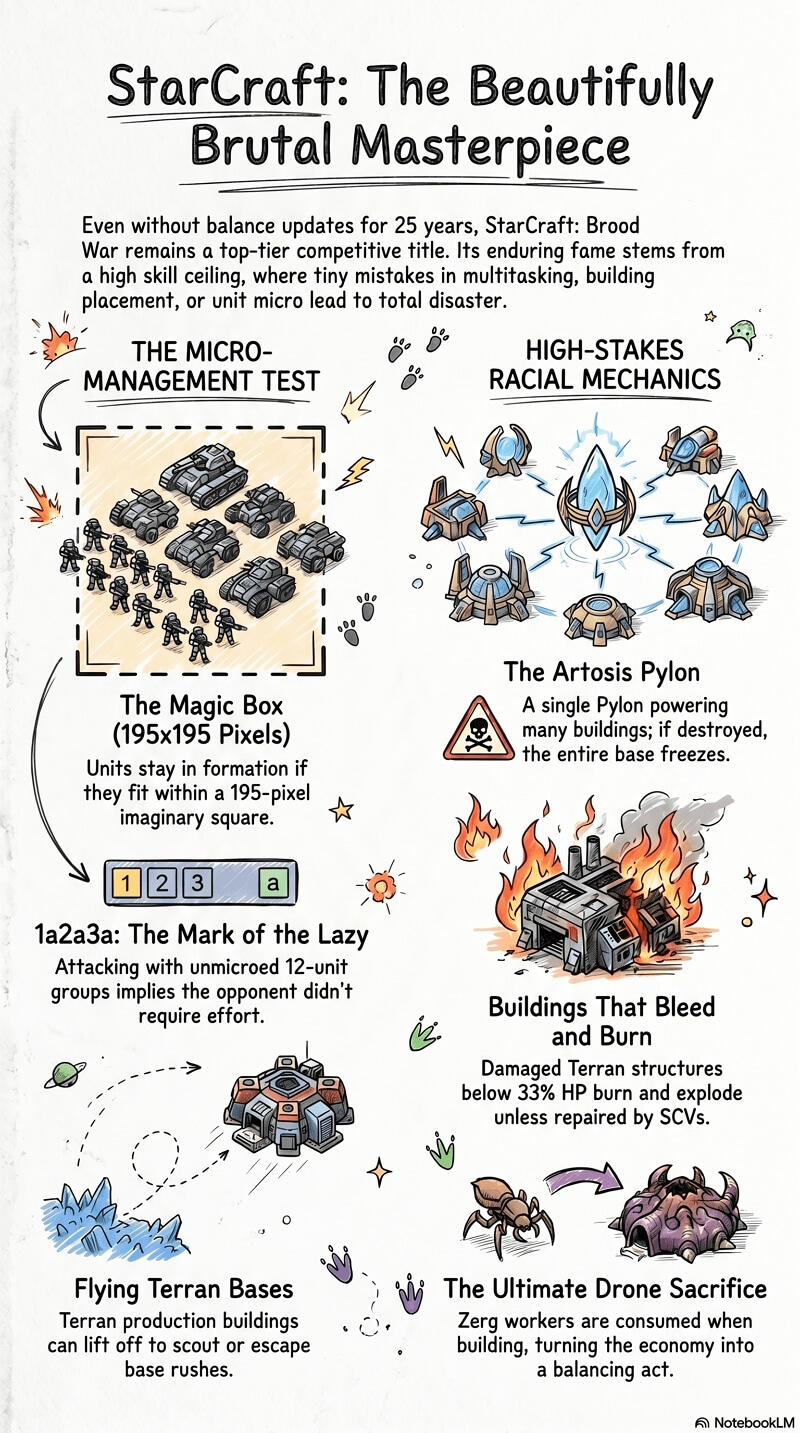
The "Artosis Pylon" — The Single Point of Failure
In the Protoss world, every building except the Nexus and the Vespene Gas Assimilator requires power from a Pylon. An "Artosis Pylon" is what happens when a player gets lazy with their base layout — using one lone Pylon to power an entire cluster of production buildings.
If that single Pylon gets sniped by a bunch of enemy units that focus it, your entire army production cluster goes unpowered: Gateways stop training units, Robotics Facilities freeze mid-build, and your production collapses into nothing. It is a total disaster during a rush.
Experienced players know to spread Pylons so no single structure powers too many buildings — often called "Pylon spreading" or good "sim-city." The Artosis Pylon is the lazy shortcut that works fine until your opponent finds it. At high levels, enemy scouts actively look for this exact mistake.
The lesson: never put all your eggs in one basket. In BroodWar, that basket has a health bar and can be killed by a single unit in under three seconds.
The Magic Box — Anti-Splash Micro
The Magic Box is one of BroodWar's most famous hidden mechanics. It describes an imaginary square that determines how your selected units move in formation. For ground units, this invisible box is roughly 195×195 pixels.
As long as all the units you select fit inside that 195-pixel boundary, they will move in a straight line — a "parallel formation" — instead of clumping together like a ball or spreading around randomly, looking like a bunch of retards. This can be critical against splash damage: a clumped squad of Dragoons or Marines is a free kill for a Lurker or a Siege Tank. A spread formation forces the mine to deal damage one unit at a time.
Players use Magic Box logic to move Dragoons or Marines in a wide firing line so every unit can shoot simultaneously instead of blocking each other. The technique requires constant unit reselection as your army moves — you are managing multiple sub-groups on the fly while doing everything else. This is why BroodWar's APM demands are so brutal: mechanics like the Magic Box are not optional at any competitive level.
"Even the pros are second-guessing their clicking, paranoid that missing a formation frame by half a second means their Irradiate won't be ready when the Mutalisks arrive."
Literal Flying Bases — Terran Mobile Architecture
Terran Command Centers and Barracks can literally lift off and float away. While it sounds absurd, it is strategically brilliant. A lifted building moves slowly across the map — slow enough to be impractical as a tanking unit, but useful enough to change the entire dynamic of several matchups.
In TvT (Terran versus Terran), a Barracks is routinely used as a slow-moving forward scout. Instead of risking an SCV on a dangerous scouting run, you fly your Barracks toward the opponent's expansion or tech lab. By the time they notice and react, you have already seen what you needed to see — and you simply fly it home or let it die.
Flying buildings are not just a curiosity — they are a resource-efficient intelligence tool. A Barracks costs 150 minerals but provides information you would otherwise need a costly unit to gather. In tight TvT games where every unit matters, spending a Barracks to scout is a calculated trade. Experienced players know exactly when the information is worth the cost — and when to fly it back before it gets shot down.
Command Centers can also relocate entirely, letting Terran players pick up and move their main base mid-game. It is the most unconventional economic play in BroodWar — and it occasionally works at the highest levels.
Zerg Drones — The Ultimate Team Players
In every other race, workers build structures and then return to mining. A Protoss Probe warps in a building and walks away. An SCV constructs a Barracks and goes back to the mineral line. Not the Zerg.
A Zerg Drone morphs directly into the building — it becomes the Hatchery, Spawning Pool, or Evolution Chamber. The Drone is consumed in the process. It does not come back.
This is why Zerg economic management is so stressful. Every building you construct is one less worker gathering minerals. You have to balance your drone count against your hatchery count against your building needs at every moment of the game. An over-invested tech tree means a crippled economy. A greedy economy means you die to the next all-in. The "Zerg Economic Guidelines" are not just suggestions — they are the difference between winning and collapsing.
The Drone sacrifice creates a uniquely Zerg tension: every early building decision is a permanent resource commitment. You do not get to keep your workers and build your base. You choose one or the other, again and again, under pressure.
1a2a3a — The Slur of the Lazy
In StarCraft, you can only fit 12 units in a single control group. By hitting the sequence "1-A, 2-A, 3-A" — attack-move on three control groups in rapid succession — you are telling three batches of units to march across the map and automatically engage anything they encounter.
It requires almost zero micro. No formation management, no focus-firing, no pathing choices. Just three keystrokes and a direction.
1a2a3a works when your army is simply larger and stronger than your opponent's — no micro required. If you win that way, you are silently communicating that your opponent was so far behind that you did not even need to use your mouse properly. At higher levels of play, it is used as a taunt. A player who legitimately 1a2a3a'd their way to victory knows it, and the opponent knows it. It is the fastest path to a grudge rematch.
On the flip side: if you find yourself losing to a pure 1a2a3a with no micro from your opponent, the problem is not their technique — it is your macro. You were outbuilt, not outplayed.
Buildings That Bleed — And Burn
Terran players live in a state of permanent low-grade anxiety that no other race experiences: their buildings catch fire and destroy themselves.
If a Terran structure drops below one-third of its maximum hit points, it begins to burn. The fire deals continuous damage over time, and if no SCV is sent to repair it, the building will eventually self-destruct — taking all the minerals and time invested in it down to zero.
When buildings are under fire, Terran players must "pull SCVs" from their mineral line to repair them. This is not free. Every second an SCV spends repairing is a second it is not mining minerals. In high-pressure situations — a Zerg Lurker push, a Protoss Reaver drop — you are simultaneously micro-managing your army, macro-managing your production, and pulling workers off economy to keep your base from burning down. The cognitive load is immense. Forgetting to repair a Barracks has ended more games than any single tactical mistake.
This mechanic applies only to completed structures — buildings under construction will not burn. Once active, however, every Terran structure is perpetually one bad fight away from self-immolation. Nothing says "StarCraft: BroodWar" quite like losing a game because you forgot to repair a burning Command Center while your army was halfway across the map.
You can figure out BroodWar's basics in a few hours. You will spend years trying to master the intense combination of fast clicking, perfect hotkeys, and split-second decisions. No matter how good your economy gets or how crisp your unit control becomes, the ranked ladder will always find a new way to humble you. Whether you are a macro machine or a micro god, there is always a smarter, faster, more ruthless opponent waiting on the other side of the queue.